Why are angels depicted on every painting, sculpture, and drawing as spiritual beings with wings? To understand the artistic portrayal of angels, one must first comprehend the perception of angels in Christian tradition. The word “angel” itself comes from the Latin word “angelus,” meaning ‘God’s messenger.’ The Latin word, in turn, originates from the Greek word “angelos,” which is a translation of the Hebrew word “malak,” meaning ‘messenger,’ ‘envoy,’ or ‘delegate.’
The Catechism of the Catholic Church states the following:
Saint Augustine, in reference to them, says: “The word ‘angel’ denotes a function rather than a nature. You ask the name of this nature, it is spirit; you ask its function, it is that of an angel, which is a messenger.” In their whole being, angels are servants and messengers of God. As they “continually behold the face of my Father who is in heaven” (Matthew 18:10), they are powerful “executors of His commands, attentive to the voice of His word” (Psalm 103:20).
As purely spiritual beings, angels possess intellect and will; they are personal and immortal creatures. By perfection, they surpass all visible creatures, a fact attested by the splendor of their glory. (CCC 329 – 330) Angels are pure spirits, meaning they do not have bodies, although they can appear in human form. The visible form of angels, as recorded in the Holy Scriptures or popular stories, is merely an external image, a mask they put on for us to see with our physical eyes.
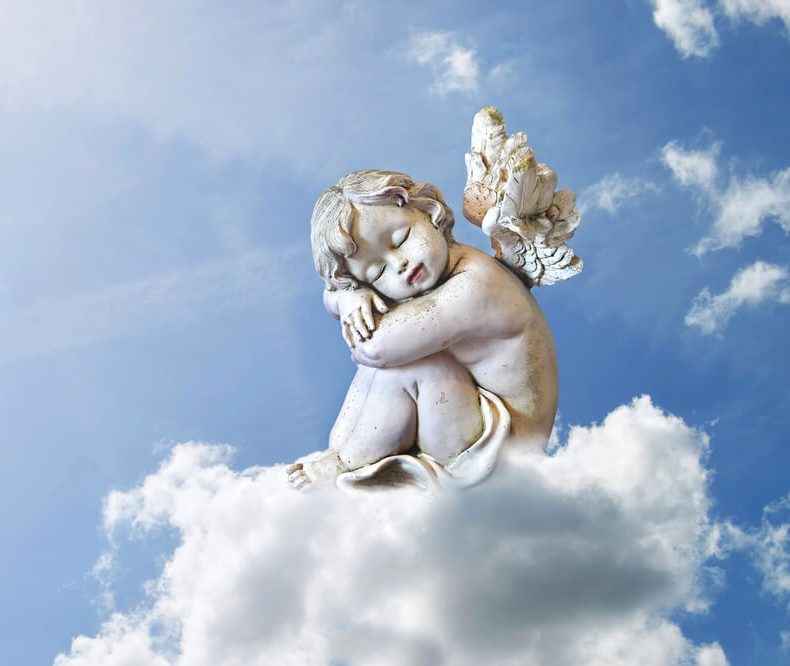
Otherwise, they are entirely invisible beings. In the early centuries of the Church, angels were depicted in art no differently than humans, and their portrayal was based on what we know about them from biblical accounts. However, somewhere in the 4th century, artists began to distinguish these spiritual beings from humans. The first known depiction of an angel with wings is found on the so-called “Prince’s Sarcophagus,” discovered in Sarigüzel, near Istanbul, dating back to the years 379-395.
Artists later always depicted angels with wings, which is associated with their role as messengers. One reason for this change in art is linked to the spiritual symbolism of birds. Birds were perceived (and utilized) in ancient times as messengers. This tradition dates back to Noah and continues in Greek mythology. The god Hermes, for example, is known as the messenger of the gods and is often depicted with wings on his helmet or cap. Greek and Roman artists naturally continued this tradition in the visual representation of angels, true messengers of God. Thus, even though angels do not have wings, such artistic expression became an excellent way to depict the service entrusted to them by God.
Credit: medjugorje-info.com